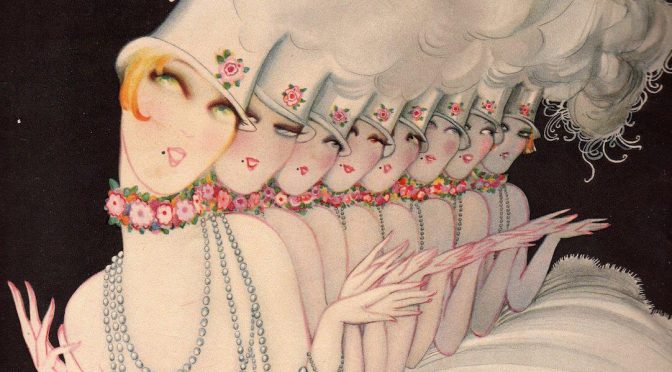
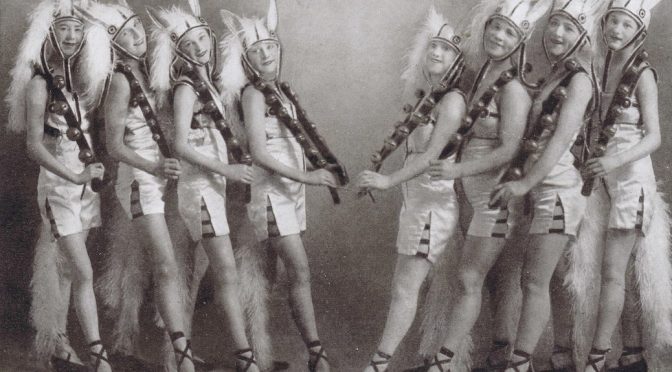
The British born costume and fashion designer Dolly Tree in addition to being prolific in London and the regions in the 1920s had a great vogue in Paris and a great love of being in the French capital. But it is also clear that she developed a strong affinity and love for Spain and Barcelona in particular.
Tag Archives: Mistinguett

Tommy Ladd
Tommy Ladd had many loves and many different dancing partners. In addition to being a famous acrobatic dancer he was also a singer. Much of his early life is a mystery and establishing his later life and career is made doubly difficult because there was another American actor also named Tommy Ladd active at about the same time. After a glittering career in Europe, he finally settled down in California, where he came from, with his wife, the comedienne Helen Boice.

The Dancer Fay Harcourt
Fay Harcourt was a British dancer who made it big dancing in Paris in the Jazz Age of the 1920s as part of three dancing teams – the first with the American Harry Cahill, the second with a Russian called Nicholas and the third wit hthe Argentinian Peppy de Albreu. But, after a glittering career from 1922-1928 she simply vanished.

The Costume Designer Zig
The costume designer Zig was the pen-name of one of the great artists for the Paris music hall in the Jazz Age. Prolific as an illustrator, creating artwork for posters, programme covers and sheet music, Zig also created stunning sets and costumes with a tremendous flair and originality from the mid to late 1920s and early 1930s, before dying at an early age in 1936. He must not to be confused with another illustrator called Zig Brunner.

Fernando (Sonny) Jones
Fernando (Sonny) Jones was an intriguing, if somewhat elusive, black performer who made his life and career in Europe and especially in Paris in the 1920s. He was an accomplished dancer and made it big headlining in the Palace Theatre show Paris Voyeur in Paris in the 1925-1926 season. Throughout his career he was closely linked to Louis Douglas, another high profile black artist.

Cafe des Ambassadeurs
Cafe des Ambassadeurs
The Café des Ambassadeurs was one of most fashionable and best-known summer venues in Paris situated on the Avenue Gabriel at the entrance to the Champs-Elysées near the Place de la Concorde. Named after the nearby Hotel Crillon that had become the residence of foreign ambassadors, it was founded in 1764 as a simple open air bar, a small pavilion was added in 1772 and it evolved into one of the most famous of the Parisian café concerts.