The British born costume and fashion designer Dolly Tree in addition to being prolific in London and the regions in the 1920s had a great vogue in Paris and a great love of being in the French capital. But it is also clear that she developed a strong affinity and love for Spain and Barcelona in particular.
Tag Archives: Dolly Tree

Dolly Tree Interview in the Daily Express 26th January 1922
I recently found a detailed interview with Dolly Tree in the Daily Express from January 1922 in the British Newspaper Archive. This feature was not available during the research for my biography Dolly Tree: A Dream of Beauty and so the information it provides was not included. So here is the text and commentary as it does show some invaluable and interesting points.
Continue reading Dolly Tree Interview in the Daily Express 26th January 1922

Brighter London at the London Hippodrome, 1923
Julian Wylie’s 1923 London Hippodrome show Brighter London was in fact the second longest running revue in London during the 1920s, being overtaken by The Whirl of the World (1924) at the Palladium. The show had no real story but comprised a series of episodes with Cupid setting out to brighten London culminating in the appearance of the celebrated American band leader Paul Whiteman and his orchestra.
Continue reading Brighter London at the London Hippodrome, 1923

Crysede and Dolly Tree
Sometime in mid 1921 the theatrical costume designer Dolly Tree became associated with the famous Cornish textile company Crysede and the owner Alec Walker.

Leap Year at the London Hippodrome, 1924
Leap Year at the London Hippodrome, 1924
George Robey was the star of Julian Wylie’s third Hippodrome revue Leap Year described as ‘one of the best revues that London has ever seen’. Launched at the London Hippodrome on 20th March 1924 it ran for 471 performances. The show had no cohesive plot but was designed to showcase the talent of Robey as a comedian and he appeared in at least 11 of the scenes, which means that in fact Leap Year was constructed around him.

Midnight Follies First Edition 1921
Midnight Follies First Edition 1921
The Whitehall Room within the Hotel Metropole became the site of one of the first true cabarets in London that transformed London’s nightlife in the 1920s. On the 2nd November 1921, the ‘Midnight Follies’ was inaugurated at the Metropole with a show that was called a ‘super dansant.’ With glorious costumes designed by Dolly Tree it became an overnight hit with all of smart London flocking to see the show designed to ‘brighten London.’

The Cabaret Follies
The Cabaret Follies
When Jack Hylton’s Cabaret Follies show made its debut in London in the autumn of 1922 it was one of four big cabaret shows that made a Brighter London, the others being located at the Grafton Galleries (Midnight Revels), Murray’s Club (Murray’s Frolics) and the Hotel Metropole (the Midnight Follies). At first its status and popularity amongst London’s high society was unassailable, but when Jack Hylton relinquished control at the end of 1923, it floundered and ceased to be by the summer of 1924.

Julian Wylie’s Revue Better Days
Julian Wylie’s last revue at the London Hippodrome was Better Days in 1925. Comprising 19 scenes, Better Days had a try-out at the Liverpool Empire from 9th March 1925 before its debut at the London Hippodrome on 19th March 1925. Continue reading Julian Wylie’s Revue Better Days

Dolly’s Revels
Dolly’s Revels
The first cabaret show to be presented by Harry Foster and Major E.O. Leadlay at the Piccadilly Hotel in Piccadilly, London was called Dolly’s Revels. It was staged by Edward Dolly, the brother of the famous Dolly Sisters in February 1924 and had costumes designed by Dolly Tree.
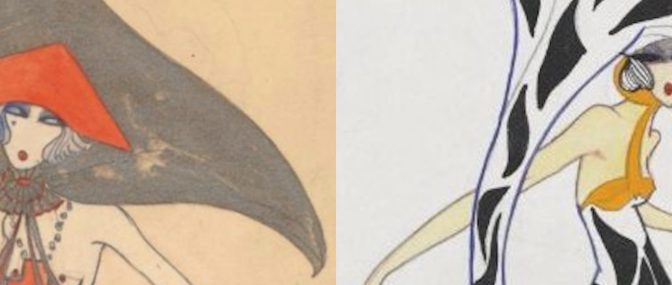
Leonard Stanley, Adrian and Dolly Tree
An interesting discovery of a sketch by the British costume designer Dolly Tree within Leonard Stanley’s book Adrian: A Lifetime of Movie Glamour, Art and High Fashion