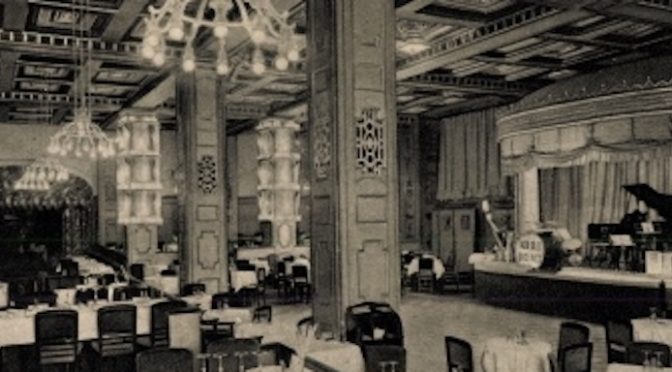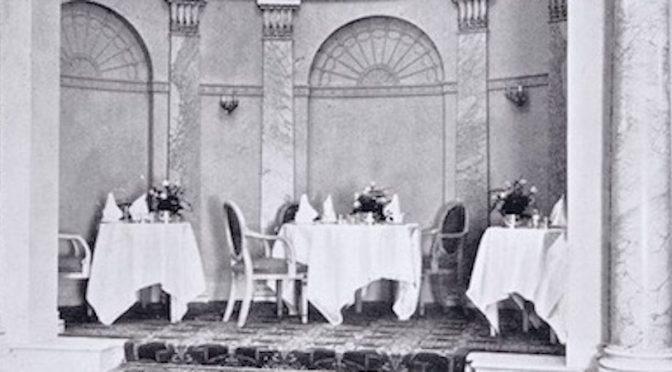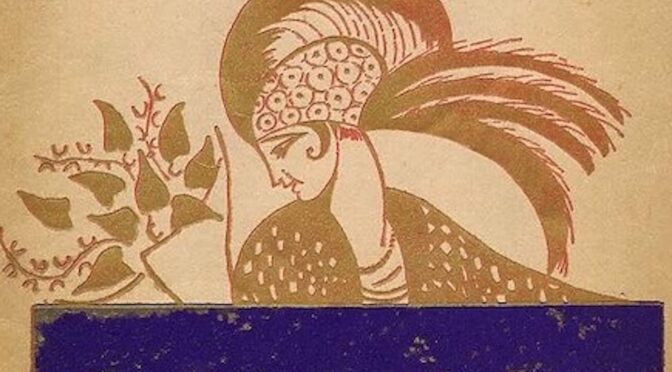
The Club Daunou was a thriving cabaret space and nightclub that opened above the Theatre Daunou in the Rue Daunou in late 1921. It became one the most fashionable nightspots in Paris during the jazz Age of the 1920s.
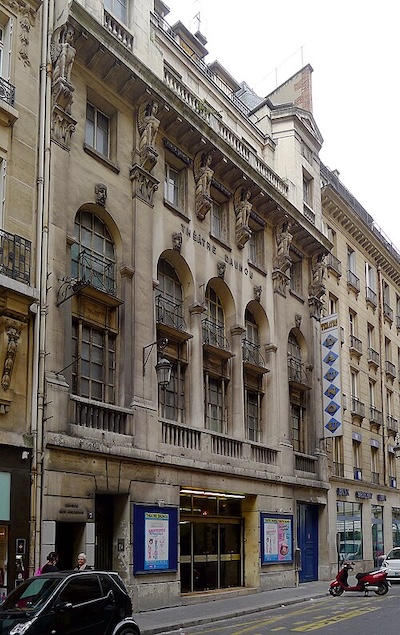
Originally the Hotel de L’Empire, the premises were sold just after the First World War and in March 1919 the contents, fixtures and fittings went up for sale. It had been announced that the actress Polaire was having a stage built in her name and that Jane Marnac was also having a theatre built by an industrial friend. It was no surprise therefore when it was revealed that 7 Rue Daunou had been bought by Jacques Wittouck and would be converted into the Theatre Daunou for the actress Mille Jane Renouradt. Wittouck intended that the new theatre would be very modern and very Parisian and was entrusted the architectural direction to Mlle Renouardi, who according to gossip was at the time his mistress.
The structural renovation was designed by architect Auguste Bluysen with the exterior in an Art déco style. The interior design was the work of Jeanne Lanvin (a close friend of Jane Renouardt) and Armand-Albert Rateau (of the Lanvin Decoration workshop). The outstanding feature of the interior décor was that it featured a deep blue colour scheme. The spectacular features included a proscenium arch bordered by gilt panels depicting fruiting vines, peacocks, monkeys and squirrels. The walls, drapes and upholstery were in velvet Lanvin blue – the trademark colour of Maison Lanvin. The decor ensured that visitors connected the fashion designer and her new interior design firm.
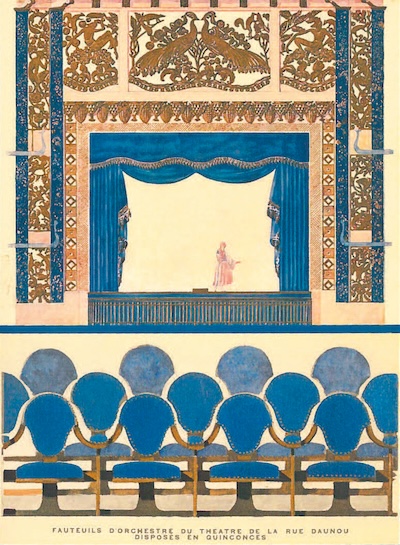
In addition to the theatre with five hundred seats, there was a restaurant and on the first floor was what was originally described as a ballroom or dance hall that eventually became a cabaret venue. The décor here was in laquer red and royal blue. The other floors above were designated for a new hotel. But how this was feasible having hotel rooms above a noisy cabaret is a mystery perhaps hotel guests were given ear muffs.
The new playhouse and associated rooms were comfortable and stylish and had been constructed with a taste and luxuriousness that were truly Parisian. Theatre Daunou and the cabaret were in an ideal position nor far from the Opera. Its location alone was ideal for the smart set as it was ideally placed for the wealthy diners from Ciro’s (6-8 Rue Daunou) who found it convenient to step across the street, customers also came from Restaurant Phillipe 10 Rue Daunou and it drew the diners from the Cafe de Paris, only a few steps farther away. It was thought to become a gathcrîng.place for ail the fashionable world of the French capital.
The Theatre Daunou was inaugurated on 30th December 1921 with C’est Une Sacree Pettite Blonde, a comedy in 3 acts by MM. Pierre Wolff and André Birabeau with a cast that included Mlles Jane Renouardt.
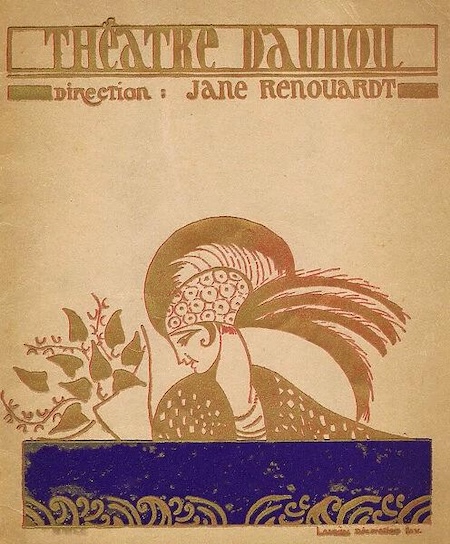
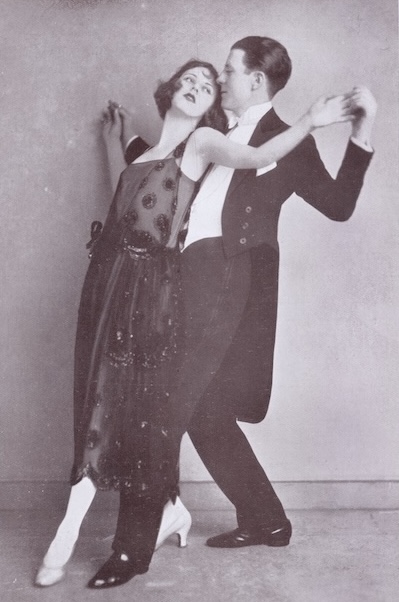
At the same time the Club Daunou opened also under the direction of Mlles Jane Renouardt. Described as a souper dansant the refreshments came from Ermitage de Longchamps, there was dancing to the Genaro Pizzaro orchestra and Johnson Jazz and a cabaret attraction from the singer France Martis. In January 1922, the English dancer Irene Hammond was added to the attractions along with her American dancing partner Charles Stuart. They had previously performed at the Clover Club in the Rue Caumartin in mid-1921.
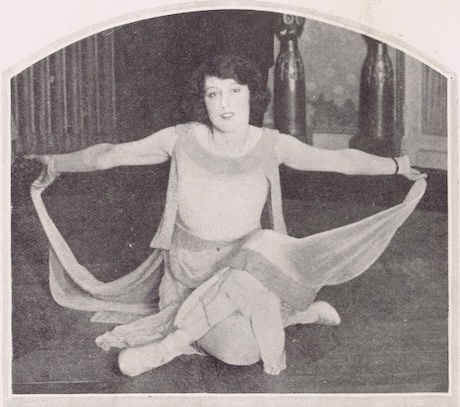
The programme changed in March 1922 with the appearance of the popular singer Perich and the popular American five-piece band from Art Hickman called Art Hickman’s New York London Five. In addition to the incomparable orchestra, in the interlude, there was the singing of Gaby Montbreuse and picturesque Russian songs from Mite Sawitzkaïa. The ‘show’ continued for several months no doubt with different guest performers.
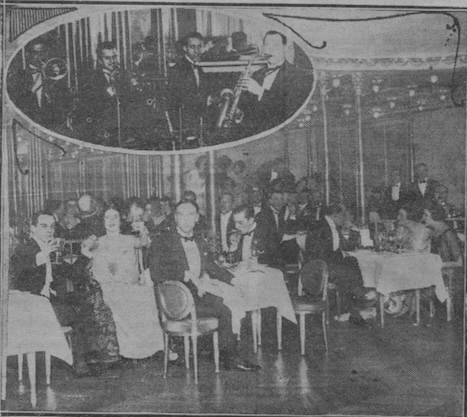
After the summer break, Club Daunou re-opened in early September 1922 with the dancing of Irene Hammond (wearing gowns by Lucile) and Charles Stuart. Both were ‘fresh’ from an engagement at the Deauville Casino that summer. At the same time the handsome and debonair American socialite Erskine Gwynn, who was not a professional, was ‘taking the place by storm’ by doing-some acrobatic dances.
By early December 1922 there was a change in programme with the inclusion of the fashionable London dancing team of Dina Harris and Ted Trevor direct from their successes at the Embassy Club and Ciro’s. Charlie Stuart continued doing amusing dances on his own.
However, by early 1923 Jane Renouardt closed the Club Daunou citing lack of attendance and low revenue. But it did not remain closed for long as it was re-opened early March 1923 under what must have been new management. A few years later in 1925 it was noted that a Mr. Symons was the main tenant of the Daunou building, but does this mean that he had taken control of the entire building or just everything but the theatre?
Whatever, someone must have been given the license to run and manage the Club Daunou which was subsequently called the fashionable souper-dansant. The opening attraction was the dancing of the American Vera Cooper and Douglas (who had been appearing at Claridge’s Hotel in Paris) and the Teddy-Thornton orchestra and Genaro. After a two-week engagement they were replaced by the British dancing team of Carl Hyson and Peggy Harris for their Parisienne debut after their appearance in London in the cabaret Midnight Follies staged at the Metropole Hotel. They caused a sensation, and following an engagement by the original Versatile Four band Hyson and Harris made a return engagement in April 1923.
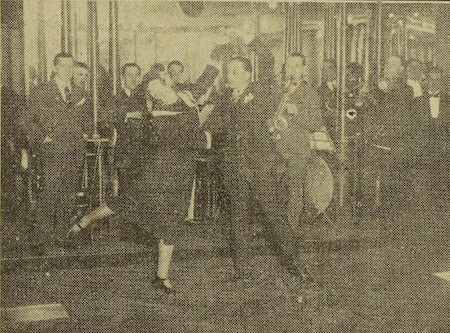
In May 1923 the dancers Joan Pickering and Charlie Stuart appeared and in June the Trix Sisters were added
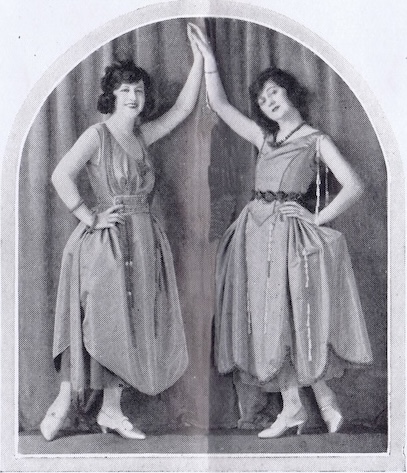
See the post on the Trix Sisters
After the usual summer recess Club Daunou re-opened at the beginning of September 1923. The venue described as ‘cosy’ had somehow been enlarged but retained its sunken dance floor. The new cabaret show featuring the Bert Ralton band, Peggy Marsh (direct from the Deauville Casino) and the British dancers the Tomson twins. The latter were in charge of the cabaret.
See the post on the Tomson Twins
The cabaret at Club Daunou continued with regular new acts being added frequently. In late October 1923 the singers Violet and Jacquita Smeller appeared along with the Tomson Twins in their new amusing skit ‘cut yourself a piece of cake.’ In early November 1923 Peggy Marsh and Ben Barette made their debut and in mid-November 1923 Hazel Shelley appeared with the dancers June Day and Jack Gavin.
Finally, on 1st December 1923, the Tomson Twins presented the Midnight Follies cabaret show with Fayette Perry (from the Grafton Galleries in London), Hazel Shelley and a beauty chorus. The costumes and décor were designed by the American designer Gordon Conway.
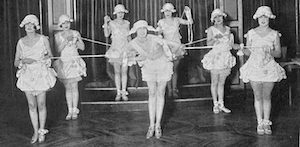
Seemingly, Mr. Symons, the main tenant of the Daunou building transferred a right of occupancy on two floors of the venue in January 1924 to the Tomson Twins. One floor was the Club Daunou and the second became a hotel.
The Tomson Twins continued to present the Midnight Follies show at the Club Daunou throughout 1924 with a variety of ever-changing acts. So, in March 1924, the cast included Fayette Perry, Winifred Dale, Edna May, Tim O’Conner, Orlova and Ira Kasime and the Midnight Follies Girls. In April – May the cast included Salma Queen of Castanettes and Josephine Head and Albert Zapp followed by Billy Revel and Betty de Laune.
A prominent guest in April 1924 was Edward the Prince of Wales incognito as the Earl of Chester along with Brigadier General Trotter and Princess Edmond de Polignac – Singer, prior to going to Le Touquet.
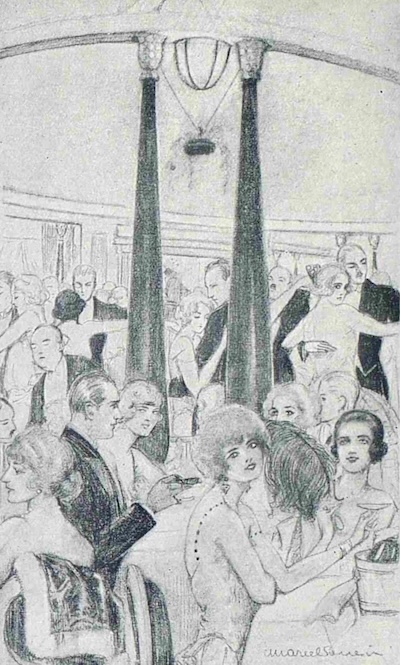
By June 1924 the Club Daunou was renamed the 400 Club and featured the American singer Norah Bayes and in July 1924 the headline act was the American dancer Dora Duby. Described as ‘Paris’s newest midnight dancing and supper club’ it was attracting many prominent members of the America set.
Another ‘guest’ was the popular Spanish singer Raquel Miller who carried a huge ostrich fan to set off any costume she wore and there was one white fan almost as big as herself to complement a white frock embroidered with diamonds.
Josephine and Albert Zapp returned to the 400 Club in September 1924 and in October the coloured singing act of Layton and Johnson appeared, followed by Yvonne George and the Cameron Sisters in December 1924.
In March 1925 a big fracas developed at the 400 Club between the Tomson Twins and Mr. Symons, the main tenant of the Daunou building. There had been numerous complaints from neighbours that the noise from the Club was intolerable. They formed a committee and petitioned M. Symons, who called a meeting with the directors of the Daunou building. Notice was given to the Tomson Twins to close the club by 25 September 1924. The twins fought the notice and petitioned for an extension of possession until January 1, 1926. In court a judge upheld M. Symon’s claim and ordered the expulsion of the Tomson Twins within a fortnight following the day the order was served. Perhaps in defiance the Twins staged a special gala with Evelyn de la Tour on 28th March 1925.
However, although there is no written proof in the press, the two parties must have finally come to an amicable agreement and the Twins continued running the 400 Club until the summer of 1925. In May 1925 the dancing team of Florence Walton and Leon Leitrim appeared at the Club with the Lido-Venice orchestra from the Lido Venice Club in New York. There was also the addition of the three Brox Sisters from The Music Box revue in New York.
This was the end of the Tomson Twins successful tenure of the 400 Club. Despite the insistence of M. Symons and the Daunou board that the club venue should be closed because of the noise the tenancy was in fact renewed. In September 1925 the 400 Club became the New Daunou under the direction of M. Gardiola and August Penzo but its success and popularity was never really regained. The new management instigated tea and supper dances with the Billy Trittle orchestra and the renowned Juan Mordrez Orchestra with the publicity line saying that the New Daunou was the ‘smartest place in Paris.’
From the 16th October 1925 the programme featured the French performer Gina Palermo, the dancers the two Roltaldo’s and Violet Doreen with the later edition of Penzo, Raoul and Jack O’Breissi (the latter was the artistic director of the cabaret show). This was followed by the appearance of the French singer and dancer Marcelle Rahna in late October 1925.
In November 1925 Rahn continued her engagement with the addition of the well-known American fantasist Esmee Davis and Vera McKinnon. Billy Trittle’s orchestra continued along with the Juan Morden tango band with the celebrated guitarist Roman Garcia.
December 1925 was a busy month. First there was the dancing Max Berger and Germaine Lambelle, then Fay Harcourt and Nicholas, followed by Zelie and Claude Anthony and then Pierrino Faraboni. Also, the management of the New Daunou changed again and the Anglo-American actor and film director took over the directorship. It was claimed that although the New Daunou was already the smartest place in Paris, Garrick intended to make it the leading place of its kind in Paris. In his new endeavour Garrick was joined by the veteran French film director and screenwriter Albert Capellani acting as artistic director. Capellani had worked in America from 1915-1922 and was recognised as bringing Alla Nazimova to prominence under his direction. A few months later Capellini was aided by Mario Jaeger.
The cabaret for Christmas 1925 under Garrick and Capellani comprised Billy Trittle and his orchestra, Joan Mordrey’s Tango Five, the eight J.S. Fisher Girls from the Palace Theatre, the June Sisters (from the Casino de Paris) and Vera McKinnon in her original dances. From 1st January 1926 the New Daunou was called The Hollywood.
Presumably in the first part of 1926 there must have been cabaret attractions but they were no listings in the press until May 1926. At this point it was announced that there would be a grand gala for the inauguration of dinner dances on 15thMay 1926 with the attractions of the Billy and Mordrez orchestra, the Two Charleston Girls, Marco and his partner, from the Theater des Champs-Elysées, and Dauvi, the fanciful singer from the Apollo.
A few weeks later there was a change of programme with the addition of the famous Dolly Sisters in their latest creations.
However, thereafter the record ends and it is not known what exactly happened to the venue. Albert Capellani died in September 1931 and by May 1929 there was mention of the Hotel Hollywood above the Theatre Daunou, so the space originally occupied by the Club Daunou may have been absorbed into the Hotel.