

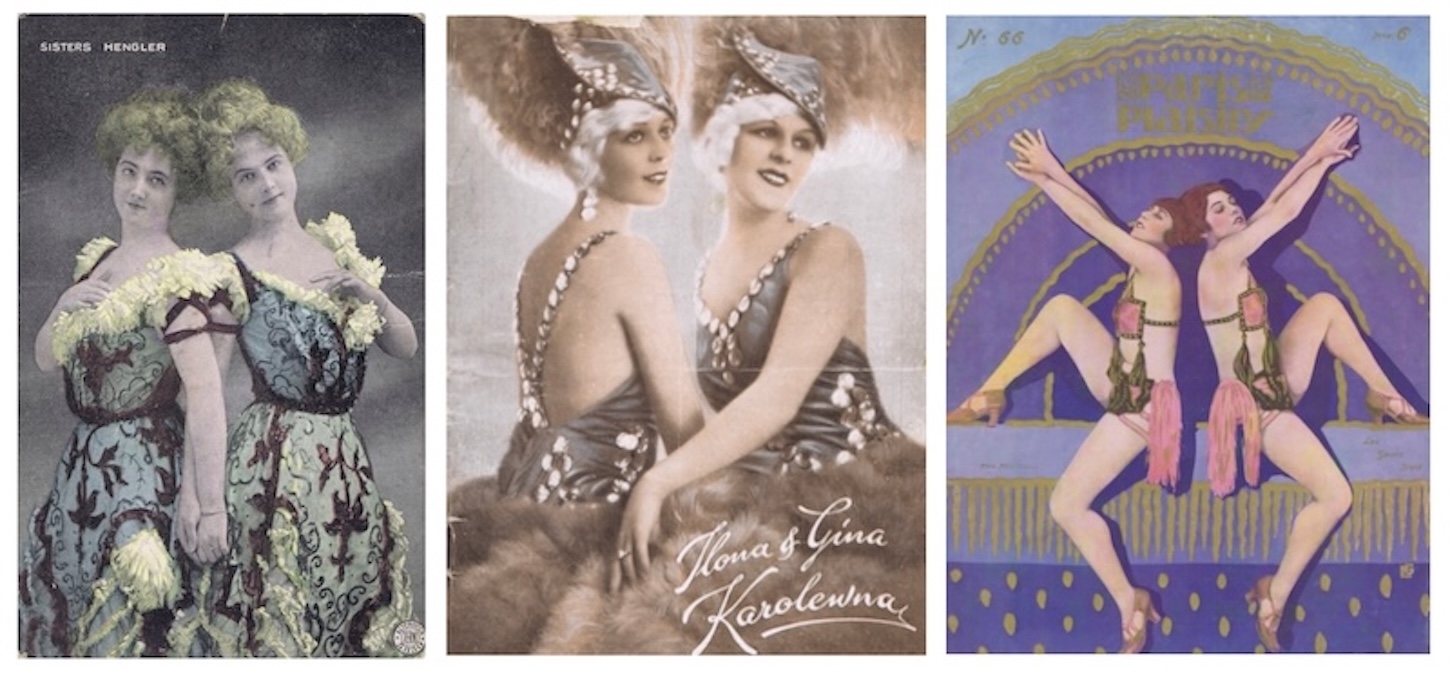
One of the most obvious fad or trend in the entertainment industry in the Jazz Age was that of twin, sister and brother acts. From the turn of century, and through the 1920s and beyond, dozens and dozens of acts became famous on both sides of the Atlantic.

‘A sister team is composed of two women closely allied to, or associated with each other by partnership arrangement for the purpose of stage exploitation and profit. That they should be born of the same parents is a matter of lesser importance and would be the occasion of great surprise. Nevertheless, sisters in fact…constitute the mainstay of vaudeville.’ Theatre Magazine (1917)

‘The vogue for sister artists is one which never palls, and American, Continental and British audiences always delight in ‘twin girl’ turns.’ The Sketch (1927)

‘This may be said to be the age of twin success… an artist always wins her way to popularity when she has ‘a sister to assist her.’ The vogue, however, is very easy to understand, for if one charming and accomplished actress and dancer can fascinate, surely when there are ‘two of a kind’ the charm exercised must be of double strength.’ The Sketch (1927)

‘The advent of twin stars on the theatrical firmament is the outstanding feature of the past fifty years.’ M. Fouquet, retired president of the Moulin Rouge, The People (1929)

See the post on the Hengler Sisters
The fascination in ‘seeing double’ reached a peak in the 1920s when twin, sister and brother acts proliferated on the stage, cabaret and in film. Their importance and influence on the world of entertainment cannot be underestimated.

See the post on the Rocky Twins
The allure of the sister or twins acts was partly because you could see double and because it was perceived as a novelty and could be effective with the aid of flamboyant and spectacular costuming.
See the post on the Lorraine Sisters
The obsession with twin acts became so profound that although some of the acts were in fact twins, others were merely siblings and in some instances made out that they were twins when they were not.
See the post on the Goode Sisters
The nationality of these acts were varied. Many of the acts were international and travelled widely between America and continental Europe and some even ventured to South America and Australia. However some were purely either American or Continental acts that stayed localised.

See the post on the Trix Sisters
Interestingly, some of the sister acts had one of the pair taking a male persona – such as the Houston Twins and the Sidell Sisters.
Certainly, the prevalence of semi-nudity on the Parisian music hall led to some of the sisters acts becoming viewed as being somewhat risqué and this became another reason for their allure.
See the post on the Dodge Twins
Some of the main acts included the Dodge Twins, the Houston Twins, the Duncan Sisters, the Irwin Sisters, Les Sœurs Guy, Les Sœurs Broquin, the Brox Sisters, the Sisters ‘G’, The Rocky Twins, Ree Bertin, the Dolly Sisters, the Tomson Twins, the Terry Twins, Lorraine Sisters, Hengler Sisters, Irvin Sisters, Dollie and Billie, Tosh Twins, Goode Sisters, Rowe Sisters, Forde Sisters, Fairbanks Twins, Souers Epp, Lorna and Toots Pounds, Trix Sisters, the Sidell Sisters, Beatie and Babs, Patsy and Vashti Taylor and the Karolewna Sisters.

Of these perhaps the Dolly Sisters were the most famous and the best known of all the twin sister acts with a truly transatlantic and international fame and they were copied voraciously. Unfortunately, today, a high percentage of images that claim to be the Dolly Sisters, on such platforms such as Pinterest are wrongly attributed causing much confusion and inaccuracies.
In terms of novelty, the Moulin Rouge even went as far as employing the Mazza, the Poggis and the Boyer sisters to appear in the Mistinguett headlining show Paris qui tourne (1928).

See the posts on the Dolly Sisters
The 1929 Warner Brothers movie Show of Shows including a segment called Meet my Sister where allegedly eight groups of Hollywood Sisters (one pair were not) performed. Each set of ‘twins’ representing a different country against a backdrop serving to illustrate each in a display of international stereotypes.

All images (unless specified in the caption) and text © copyright Gary Chapman / Jazz Age Club and must not be re-used without prior consent









Gary,
Thank you once again for a truly fascinating article.
Your amazing research and fine writing style are always appreciated.