The Tomson Twins were British performers who became famous during the Jazz Age in London, Paris and New York. Their varied career was as varied as their marriages and they not only danced and sang but also became nightclub and theatrical managers. From the evidence they may have been described as loveable rogues .

The Tomson Twins were born on 20th December 1894 (although sometimes the date was listed as 1895) in Acton Lane, Acton Green, London as John (referred to as Jack) Armand Tomson and Randolph Joseph Tomson (referred to as Joe or Tommy). Their father was Armando Figuardos de Tomson of Portuguese descent and their mother Elizabeth Powell who was born about 1870 in Wales. No details confirming their birth details or early life can be found nor is there any information about their father, other than one listing suggested he died in 1896 in Argentina. They were both 5 foot 7 inches tall with dark hair, classic dark sultry Latin looks, and were totally identical. It was said that they could only be told apart because one sang baritone and the other tenor.
Their first credited performance came with appearances (billed as Jack and Joe Tomson as guests at the garden party) in A Garden of Mirth, a musical and dancing extravanganza at the Winter Gardens, Blackpool staged by John R. Huddlestone and John Tiller in July 1912. John Tiller then used them in his ballet Lively Lucerne that toured in 1913. The show had smart dancing, catchy music, lots of wholesome fun and pretty girls and the Tomson Twins were observed to be very funny as two comic servants.

In late 1913 they both separated as an act with Randolph (Joe) Tomson pairing with Wilmot Karkeek giving original Argentine tango demonstrations at Tango Teas and John (Jack) Tomson with Maggie May as a delightful singing turn that included his own composition ‘Come Sing to me’. Both toured the UK.
They re-united for the revue Go Ahead by F.H. Reeves during 1914 that toured the UK including the Victoria Palace in London (March and May) and the Oxford Theatre, London (1 June -26 July for 8 weeks). During the London run, Randolph (Joe) married the actress Rose Russon in Fulham. Prior to this she had been performing in some capacity in America.
After the tour of Go Ahead, the Tomson Twins, described as ‘Artistes’ departed Liverpool on 31stOctober 1914 arriving in New York 8th November. Considering that World War 1 had broken out on 28thJuly 1914 this was an odd move. It is likely that they had been given a contract to appear in America but there are no indications of what. Whether they stayed in America between 1914-1917 or returned to the UK is not known.
In November 1917, they both joined the Royal Flying Corps Canada in Toronto and trained to be pilots. In May 1918 they were transferred to the RAF, presumably travelling back to England. Both took the rank of Second Lieutenant.
Where they were stationed and what they did during the war is not known but John (Jack) was gassed and Randolph was badly wounded when he was shot down and a bullet passed through his back, a fraction of an inch from his spine. The injury kept him in bed for many months and he spent sometime in the Royal Herbert Hospital from November 1918. They both underwent ‘different trying experiences’. Although the war finished in November 1918, they were not discharged until April 1919.
They were decorated for bravery by King George V. After the King decorated the first one, he stepped back and twin number two stepped forward, The King stopped in surprise and said ‘Why Sir, I just decorated you a moment ago’. He swiftly realized his mistake and decorated the second twin.
After being demobilised from the Air Force, they stepped into the American musical comedy Nobody’s Boy presented at the Garrick Theatre, London launched on 9th July 1919 by J.L. Sacks, Percy Hutchinson and Sir Alfred Butt. Starring Donald Calthrop and Daisy Burrell, the dances were arranged by the American Jack Haskell and performed by the Tomson Twins, Connie Emerald and Johnny Dale. It was noted that the dancing was well arranged and executed.
In the midst of their new success in London it was revealed that Randolph had deserted his wife Rose and their child. She had been dancing in the chorus of the Winter Gardens Theatre in Blackpool and had been in pantomime in Leeds. She went to a court in Leeds in July 1919 claiming that her husband had earned £15 a month as an officer in the Air Force but in 4 years had only sent her £5. She claimed that he had lied by saying he had gone to Canada. Randolph claimed that his situation was awkward as he had just got out of the army and had just acquired his first stage engagement. He said his salary was small and he was having to pay off debts incurred since being in the army. Despite protests, he was instructed to pay 40s a week and Rose took custody of the child.
After touring in Nobody’s Boy they departed Liverpool and arrived in Philadelphia on 15th February 1920, listing their mother Elizabeth Tomson living at 49 Ravenscourt Gardens, Hammersmith. They travelled first to New York to begin rehearsals for a spectacular cabaret revue called Marigold Frolics to be staged in the Marigold Rooms of the famous Bismarck Gardens in Chicago. One wonder’s how they got this contract.

The Bismarck Gardens were located at the southwest corner of Grace and Halsted Streets in Chicago’s Lakeview neighborhood and opened in 1895 catering to the local and sizeable German-American population. It became a popular summertime venue with shady trees, an outdoor stage and dance floor with electric lamps. By 1915, because of the war, the venue was renamed the Marigold Gardens with the addition of a new splendid indoor ballroom named the Marigold Rooms designed to open all year round.The beautiful new room could seat 1,400 at tables enjoying the finest cuisine and service and the best revues on any stage in America along dancing between numbers.
The new cabaret show opened 10th March 1920 and was staged by Elmer Floyd and featured Alice Maison described as the world famous dancing bathing girl along with a chorus of 20 beautiful girls and costumes created by Lester. Various new acts were added every few weeks but the dancing of the Tomson Twins continued throughout the summer.
A second edition was launched at the end of April 1920 with a larger chorus of 30 girls and was described as ‘America’s largest revue’ and the most pretentious revue in the history of the classy resort. News acts included Collins and Hart vaudeville artists, the dancer Homer Roberts, the tenor Herbert Sherman, the singing of Edith Allan and the pantomime beauty Lilyan Lee.
On 28th May 1920, there was a special performance called The Equity Frolic given at the Cameo Room at the Hotel Morrison that featured the dancing of the Tomson Twins and a chorus from the Marigold Gardens.
By June 1920 more than 35 people were employed in the Marigold Frolics revue that began nightly at 7.30 and ran until 1am with 6 big spectacular scenes. Among featured players at this time were Rita Gould, Kate Pullman (danseuse) Edith Allan (prime donna), Woodward and Morrissey (hank the mule), Marie Burke, the Tomson Twins, Loretta Ray and Georgia Howard. At this time, John (Jack) Tomson married Vivian Lucas on 10th June 1920 in Chicago.
At the end of November 1920, the Tomson Twins were back in New York and were secured by Florenz Ziegfeld to appear in his Midnight Frolic show, at the New Amsterdam Roof alongside the already famous American Fairbanks Twins (Madeline and Marion). The show had opened in September and the two set of twins were to appear in a new novelty quartette number that may have been a later addition. A new show was in fact launched in February 1921 with a cast that included the Fairbanks Twins and it is likely, but not confirmed, that the Tomson Twins were also included.
In March 1921 it was revealed that both the American Fairbanks Twins and the Tomson Twins had been signed to appear in Erlanger’s musical comedy Two Little Girls in Blue along with Vanda Hoff and Evelyn Law as principal dancers. The Tomson Twins took the roles of the stewards of the ship on which the action of the play takes place. To help promote the show in May 1921, the Twins flew a plane from Garden City, Long Island over Manhattan that caused a great deal of excitement around Times Square as they dropped miniature dolls dress in blue. The show subsequently went on tour in September 1921 and at this time a newspaper report claimed they had been offered $10,000 by Sir Oliver Lodge, a famous English scientist to assist in demonstrating telepathy and that he had indeed conducted experiments on them and demonstrated that they thought exactly the same thoughts at the same time.
Jack Tomson and his wife Vivian travelled back to Liverpool from New York in May 1922 and Randolph Joseph married Ruth Hanson in Indiana in July 1922 and both arrived in Southampton mid-August 1922. They had both been signed for a new musical comedy entitled Angel Face staged by Norman J. Norman, first at the Opera House, Blackpool in mid-September 1922 and then at the Strand Theatre, London in October. The show starred Mabel Sealby and Winifred Barnes and the Tomson Twins did a speciality dance act with Sybil Verrey. However, the show failed to shine and was a flop.
The Tomson twins were then due to open in the Albert de Courville show Smoke Rings but they informed him they had to back out because they had been offered an alternative engagement in New York. De Courville threatened to prevent them from leaving with a court order but they sailed on 11thNovember for New York. They had been booked by the American producer Henry W. Savage, for inclusion in his show The Clinging Vine at the Knickerbocker. However, when Savage met them as they disembarked from the liner Berengaria, he was totally dismayed as he thought he had booked a set of female twins not male twins. A very expensive mistake given that the Tomson twins and spouses had travelled on return first class tickets and had been booked for six weeks, not to mention the colossal embarrassment at this colossal faux-pas.
After a period of inactivity, they emerged in the cast of Take A Chance, the new Phillips-Orlob musical comedy launched out of town in Wilmington in early February 1923. The Tomson Twins were described as a good dancing team but had far too little to do. After a few weeks the show was apparently being revised for a Broadway launch but it was shelved until the summer. As a result both twins returned to London in late February 1923.
Immediately, they were asked to stage a new cabaret show at the Grafton Galleries Club. For many years the Grafton Galleries had been ‘the valhalla of dancing’ but it had been re-organised as a club in late 1922 with a cabaret show. The new show created by the Tomson Twins was called Grafton Gambols and was staged in mid-April 1923 and starred the American Fayette Perry, Violet Doreen, The Dolores Twins and of course the Tomson Twins themselves. A month after the launch, Paul Whiteman and his band were added to the cast of the cabaret along with Whiteman’s wife the dancer Vanda Hoff. Whiteman was performing in the London Hippodrome show Brighter London and so played at the Grafton Galleries during dinner at 8.30 until 10 and then came back after the Hippodrome show just before Midnight.
In the summer of 1923, the Tomson Twins were enjoying success at the Kursall in Ostend but by the end of July 1923 they were in Paris and had joined a mini-cabaret performance orchestrated by Carl Hyson at L’Ermitage de Longchamps in the Bois Boulogne. The show also featured Hyson dancing with Peggy Harris along with the Bert Ralton and his New York Havana band and ran through August 1923.
At the beginning of September 1923, the Club Daunou (atop Jane Raynouard’s theatre at 7 Rue Daunou) re-opened with a cabaret show featuring the Bert Ralton band, Peggy Marsh and the Tomson twins. The twins, in charge of the cabaret, scored big time during the 1923 winter season and were admired for their clever dancing and latest song hits. They also became very much part of the Paris social scene and were seen out and about at many other functions.

In addition to their appearances at the Club Daunou, the Tomson Twins also appeared on a variety bill at the Alhambra with Edith Kelly Gould at the Alhambra, Paris. Gould had been an actress before marrying the millionaire Frank Jay Gould but following her divorce in 1919 she returned to performing before marrying the English theatrical producer Albert de Courville. A court case erupted as a result of this association. The Tomson Twins had secured the negro band The International Five via their agent Charles Brazell to perform at the Club Daunou for three months and with the act at the Alhambra. At the last minute they were not used and another band was accordingly engaged to play. The reason given was that the band were late for rehearsals and believed they were entertainers as well as musicians and negro entertainers were not applicable in the club. The clientele of the Club Daunou was largely Americans and racist undertones were clearly in evidence. In addition, it was revealed that Albert de Courville, acting for Edith Kelly Gould, objected to having colored men on the stage with her.
The cabaret at Club Daunou continued with regular new acts being added frequently. So in late October 1923 the singers Violet and Jacquita Smeller appeared along with the Tomson Twins in their new amusing skit ‘cut yourself a piece of cake.’ In early November 1923 Peggy Marsh and Ben Barette made their debut; in mid-November Hazel Shelley appeared with the dancers June Day and Jack Gavin and in December the cast included Fayette Perry (rom the Grafton Galleries in London).
Seemingly, Mr. Symons, the main tenant of the Daunou building transferred a right of occupancy on two floors of the venue in January 1924* to the Tomson Twins. One floor was the Club Daunou and the second became the hotel.
The Tomson Twins continued to present the Midnight Follies show at the Club Daunou throughout 1924 with a variety of ever-changing acts. So, in March 1924, the cast included Fayette Perry, Winifred Dale, Edna May, Tim O’Conner, Orlova and Ira Kasime and the Midnight Follies Girls. In April / May the cast included Salma Queen of Castanettes and Josephine Head and Albert Zapp followed by Billy Revel and Betty de Laune.
However, the Tomson Twins chose to visit Vienna and had a 6-week engagement at the Ronacher Theatre in an Emil Schwarz revue called Alles per Radio during March and April 1924. They appeared in a segment called ‘An English Cabaret’ with Stella Maris from London, Lily Damita from the Casino de Paris, the dancers Roberts and Sawyer, the dancers Perot and Taylor and a group of English chorus girls.
By June 1924 the Club Daunou was renamed the 400 Club and featured the American singer Norah Bayes and in July 1924 the headline act was Dora Duby..
See the post on Dora Duby here
Josephine and Albert Zapp returned to the 400 Club in September 1924 and in October the coloured singing act of Layton and Johnson appeared, followed by Yvonne George and the Cameron Sisters in December 1924. In the meantime, the Tomson Twins, for some reason, appeared for a limited engagement from mid-November 1924 at the Moscovite Restaurant, 24 Rue Caumartin. From midnight they staged a revival of their songs and dances and a new repertoire.
In March 1925 while the Tomson Twins appeared with the American dancer Evelyn de la Tour a big fracas developed at the 400 Club between the Twins and Mr. Symons, the main tenant of the Daunou building. There had been numerous complaints from neighbours that the noise from the Club was intolerable. They formed a committee and petitioned M. Symons, who called a meeting with the directors of the Daunou building. Notice was given to the Tomson Twins to close the club by 25 September 1924. The twins fought the notice and petitioned for an extension of possession until January 1, 1926. In court a judge upheld M. Symond’s claim and ordered the expulsion of the Tomson Twins within a fortnight following the day the order was served. Perhaps in defiance the Twins staged a special gala with Evelyn de la Tour on 28th March 1925.
However, although there is no written proof in the press, the two parties must have finally come to an amicable agreement and the Twins continued running the 400 Club until the summer of 1925. In May 1925 the dancing team of Florence Walton and Leon Leitrim appeared at the Club with the Lido-Venice orchestra from the Lido Venice Club in New York. There was also the addition of the three Brox Sisters from The Music Box revue in New York. In early June 1925 Walton and Leitrim along with the Tomson Twins performed at a gala fete in Madrid given in honour of the King of Spain at the American Embassy.
This was the end of the Tomson Twins successful tenure of the 400 Club. Despite the insistence of M. Symons and the Daunou board that the club venue should be closed because of the noise the tenancy was in fact renewed. In September 1925 the 400 Club became the New Daunou under the direction of M. Gardiola and August Penzo but its success and popularity was never really regained.
At the same time there were reports that Jack Tomson was engaged to the American dancer Barbara Bennett. Bennett was at the time partner to the great ballroom dancer Maurice Mouvet and had been in Paris in May and June 1925 dancing at the Embassy (Jardin de ma Souer) and the Champs Elysees Music Hall. She had returned to New York in early September 1925 and allegedly the marriage was to take place in the Spring of 1926. Jack had been divorced from Vivian Lucas in Chicago in about 1924.
Jack Tomson then departed for New York arriving 18th September 1925 with the intent of opening a new 400 Club in New York. Randolph (Tommy) Tomson then followed with his wife Ruth in early October 1925.
A new 400 Club in New York did not materialize and for some reason they spent the first half of 1926 (January – June) performing in a mini-revue, cabaret show at the Crillon Hotel in Chicago. At some point the twins relocated to New York and in October 1926 became part of a cabaret show called the Caravan Frolics of 1926 at the Caravan Club located on the site of the old Fifth Avenue Club at 683 5th Avenue. The show was headed by Jane Gray and was called a ‘Continental Edition’ and had the Jerry Friedman’s orchestra. It fast became the mecca for nightclub habitues being close to the theatre district.
The cabaret had been staged first in late 1925 in a different venue and at the time it was revealed that the two people behind the place was Jane Gray (described as a society woman) and C. A. Newman, both known in uptown restaurant circles. For the 1926 show it was noted that the real attraction was Jane Gray who was a charming hostess with her personality and excellent singing. It is not inconceivable that Jane Gray was in fact the singer and recording artist whose real name was Peggy English (it is known that she used ‘Jane Gray’ as a pseudonym) who also appeared singing on the radio at the time billed as Jane Gray’s Club Caravan programme. The 1926 show continued on into early 1927.
What the Twins did for the rest of 1927 is not known but on 27th September 1927 Jack (John) Tomson married Josephine Vroom in Manhattan. Described as a debutante, she was born in 1906 in Syracuse and her father was a tailor. It was reported that Jack would give up the stage in order to marry and entered into some form of 9-5 job (‘in trade’) while his brother Tommy (Randolph) would dance alone in the future.
This did not last long and in late 1928 both brothers were cast in a cabaret show called Versailles Varieties. This was the opening show at the new Versailles nightclub at 14 East 60th Street created by the apartment hotel operator Charles Morton Bellack. The Versailles resembled the mirror room of the Versailles Palace and was in the basement with another venue called the Villa Venice on the ground floor.
The show was in fact more of a variety line up with dancers predominating, including Carl Randall and Virginia Watson, the Keating Twins along with the Tomson Twins. It was felt that there was not a big name on the bill that was an established night club draw and as a consequence the show and venue did not succeed.
In May 1929 a son (John) was born to John and Josephine and in the summer of 1929 it would appear that both Tomson Twins returned to London for a few weeks. There were further transatlantic crossings in the early 1930s and in July 1931 Randolph (Tommy) married Helen L Fisher in Brentford, Middlesex. Presumably both were working in some theatrical capacity in America and still earning a living. Indeed, in 1934 in London, it was reported that the Tomson Twins had spent the previous seven years producing shows in the USA. But if this was true what were the shows that they produced ?
Having formed Tomson Productions Ltd, in late 1933 it was announced that they would be producing a revue by Herbert Farjeon entitled Why Not Tonight in London. It was staged first at the Palace Theatre, Manchester on 22nd March 1934 before a London run at the Palace Theatre from April to August 1934 and thereafter at the Vaudeville. The stars of the show were Nelson Keys, Greta Nissen and Hermoine Baddeley, Mme Markova appeared as the principal dancer in a ballet and the Tomson Twins and the Blackburn Twins also appeared in some numbers. The show was ‘divided into a number of brief and disconnected episodes from the cynically modern to the fantastic and picturesquely romantic and imaginative.’ There was expert staging, an effective chorus, talented principles, tuneful music and striking costume design by Gordon Conway. Hermoine Baddeley was replaced by Florence Desomnd who gave superb imitations of Mae West, Greta Garbo, Katherine Hepburn and Tallulah Bankhead.
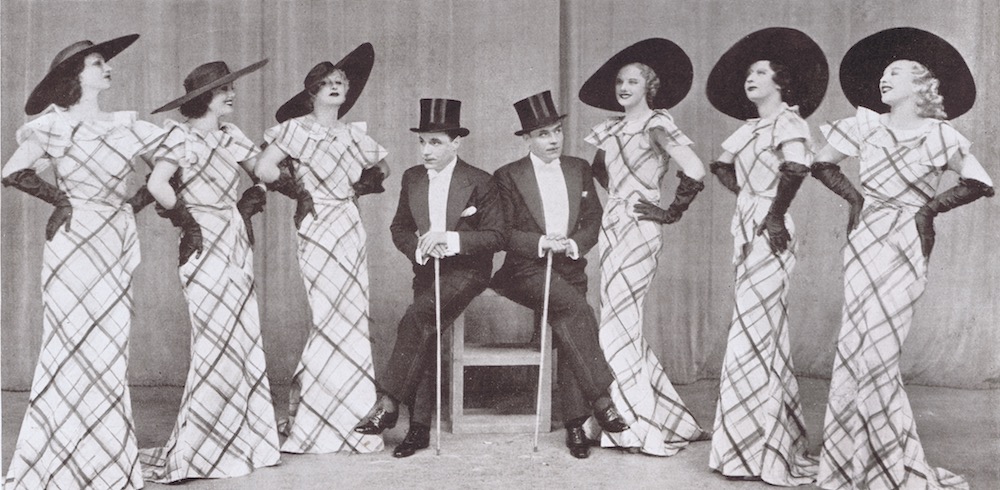
Why Not Tonight was described as a ‘witty revue… bright and brisk with never a dull moment and plenty of dancing’ and a ‘very entertaining revue, in which the formula of song, sketch, ballet and imitations of famous stars has been prepared with an expert hand.’
Following the success of Why Not Tonight in the summer of 1934, the Tomson were reported to be keen on taking a lease on the Grafton Galleries and opening a new ‘nitery’ or night-club. Presumably this did not materialize.

However, Tomson Productions Ltd did present another play entitled Delusion by Martin Brown in 1935. Set in a Berlin Theatre it concerned the struggle of a Russian ballet impresario inspired by the life of Diagheliv but it was not reviewed favourably.
The brothers appear to have stayed in London and their productions company continued based at 7 Seymour Street. In 1939 Randolph was listed as divorced and living at 1 Duchess Street, Marylebone. John was married and living at 120 Queens Gate, Kensington. His wife Josephine was in America and a daughter Barbara was born so he clearly spent time in the UK and America.
Randolph carried on living in London during the war and married Nellie Patricia Green (Patricia Morne) who was performing at the Windmill Theatre in February 1940. In the 1940s Randolph became a film director working on The Lady From Lisbon (1942), Dear Octopus (1943), Bees in Paradise (1944) What do We do Now (1945), Great Day (1945) and Chorus Girl (1948).
In the midst of this activity in May 1943, Randolph, described as formerly of the Palace Theatre and now Piccadilly House, 33-37 Regent Street and a theatrical producer, was given a bankrupt discharge suspended for one year and 6 months and was proven guilty of misconduct in relation to his property and affairs.
John Armand’s marriage to Josephine must have faltered because in 1946 he was living in Hove, Brighton and oddly changed his name to Armando Tomson or Figueiredo (or versions thereof). In late 1946 he was back in America and in early 1948 he married his third wife Betty Joan Colman in Santa Monica and they had two daughters Joan (1949) and Eileen (1953). He became naturalised American citizen in November 1950 and lived in Los Angeles.
In 1948 Randolph again went through another bankruptcy order. He and his wife Patricia relocated to California in January 1950. They both continued their careers in showbusiness. Randolph producing theatre and Patricia acting and modelling and then running a casting agency. Oddly, Randolph also changed his name to Joseph Powell Tomson.
Randolph died in April 1971 in Los Angeles and John died in August 1975 in Los Angeles.
Sources
Ancestry.com
The Fruit of the Family Tree by Albert Edward Wiggam
The Stage 11/7/12
The Era 22/2/13
The Era 9/4/13
The Era 12/4/13
http://www.leodis.net/playbills
Lincolnshire Echo 22/11/13
The Scotsman 2/12/13
The Scotsman 9/12/13
Western Chronicle 12/12/13
Bournemouth Graphic 27/2/14
Newcastle Journal 23/3/14
Daily Record 1/4/14
The Era 20/5/14
The Era 27/5/14
Western Daily Press 22/8/14
Pall Mall Gazette 28/6/19
The Stage 17/7/19
Yorkshire Post 29/7/19
The Stage 18/9/19
Variety 5/3/20
Variety 9/4/20
Variety 30/4/20
https://jazzagechicago.wordpress.com
Dramatic Mirror May 1920
The Daily National Hotel Reporter 7/6/20
CT 23/5/20
CT 7/6/20
NY Clipper 19/5/20
The Stage 9/12/20
Vaudeville News 3/12/20
The Stage 9/12/20
NY Tribune 20/12/20
NY Clipper 29/12/20
Variety 31/12/20
Billboard 19/3/21
The Stage 19/5/21
Evening Telegram 31/5/21
Vaudeville News 10/6/21
Vaudeville News 30/9/21
Buffalo Courier 15/1/22
The Era 20/9/22
Variety 20/10/22
The Stage 12/10/22
Variety 10/11/22
Variety 15/12/22
Variety 22/12/22
The NY Clipper 7/2/23
Variety 8/2/23
Vaudeville News 23/2/23
Dancing Times July 1923
The Bystander 11/7/23
The Sportsman 13/4/23
The Sportsman 13/4/23
Illustrated Sporting & Dramatic News 12/5/23
The Tatler 16/5/1923
The Tatler 30/5/23
Dancing Times July 1923
The Bystander 11/7/23
Le Journal 3/7/1923
Chicago Tribune 12 /7/23
Chicago Tribune 25/8/23
New York Herald 26/7/1923
Chicago Tribune 7/9/1923
Chicago Tribune 21/9/1923
Chicago Tribune 22 Sept 1923
Dancing Times Oct 1923
Chicago Tribune 9/10/23
Chicago Tribune 19/10/23
New York Herald 13/11/1923
New York Clipper 16/11/23
New York Herald 31/10/1923
Chicago Tribune 2/11/ 1923
New York Herald 24/11/1923
Dancing Times December 1923
Chicago Tribune 1/12/1923
Chicago Tribune 7/3/1924
Chicago Tribune 5/4/1924
Weiner Morgenzeitung 21/3/1924
Wiener Neueste Nachrichten 24/3/1924
Chicago Tribune 8/5/1924
Chicago Tribune 28/5/1924
Chicago Tribune 18/6 1924
Chicago Tribune 3/7/1924
New York Herald 12/9/1924
New York Herald 8/10/1924
New York Herald 21/11/1924
New York Herald 4/12/1924
Chicago Tribune 20/12/1924
Chicago Tribune 18/3/1925
Comœdia, 20/3/1925
Chicago Tribune 21/3/1925
Chicago Tribune 28/3/1925
Vogue US 15/5/1925
Chicago Tribune 13/5/1925
Chicago Tribune 14/5/1925
Chicago Tribune 29/5/1925
Variety 3/6/25
Variety 10/7/1925
Billboard 2/7/1925
New York Herald 12/9/1925
New York Herald 14/9/1925
Fort Worth Record-Telegram 27/9/1925
Billboard 3/10/1925
Variety 20/1/1926
Variety 27/1/1926
Variety 17/2/1926
Variety 30/6/1926
Variety 7/10/1925
Variety 27/10/1926
Variety 10/11/1926
Yonkers Statesman 26/11/1926
Variety 15/12/26
Variety 12/1/1927
Times Union 4/2/1927
http://www.jazzage1920s.com/peggyenglish/peggyenglish.php
The Republic 21/9/1927
Variety 19/12/1928
Variety 2/1/1929
Variety 9/1/1929
The Stage 7/12/1933
Daily News 7/3/1934
The Stage 29/3/1934
The Stage 26/4/1934
The Tatler 16/5/1934
Theatre World June 1934
Variety 10/7/1934
The Stage 9/8/1934
The Stage 4/4/1935
Kineweekly 14/5/1942
Kineweekly 14/1/1943
Kineweekly 28/6/1945
London Gazette 18/5/43
London Gazette 12/7/46
London Gazette 28/12/48
London Gazette 11/2/49