Tommy Ladd had many loves and many different dancing partners. In addition to being a famous acrobatic dancer he was also a singer. Much of his early life is a mystery and establishing his later life and career is made doubly difficult because there was another American actor also named Tommy Ladd active at about the same time. After a glittering career in Europe, he finally settled down in California, where he came from, with his wife, the comedienne Helen Boice.
Tommy Ladd was born Clarence Joseph Laventhal on 7th July 1905 in Los Angeles (however, some sources say it was 25th May 1906). His father was Henry (of German ancestry) and his mother Christina (nee Anderson) was of Scottish ancestry. The family were living at 1906 Michigan Avenue in 1910 and Henry was listed as being a painter in the city fire department. Clarence had five siblings: Victor (born @ 1898), James (born @ 1902), Cordelia (born @1904), and Lewistone (born @ 1909). The family were living in the same location in 1920 but by 1930 the family had moved to 1714 12th Street, Santa Monica.

In the mid 1920s Clarence was performing as a singer and so singing not dancing may have been his first love. In July 1924 he was singing as a tenor on a radio station in Long Beach along with Al Schiller (Pianist) and White’s Californians. A little later, in late 1926, Clarence (tenor) was part of a benefit programme in support of his sister Cordelia (soprano) for the Greater Highland Park Post American Legion. Another performance was listed in February 1927 for the Californian Federation of Women’s clubs.
During 1927, the newly named Tommy Ladd (why he took this name is not known), had turned to dancing. This change had certainly happened very fast, that suggests that perhaps he had also been dancing in California whilst he was singing.
In a strange newspaper post it was announced that he had just arrived in New York from Paris and was to become the dancing partner of Lisbeth Higgins. Sadly, there is no confirmation that Ladd did make a trip to Paris or what the nature of such a trip was. It may have just been fiction to improve his image and legitimacy as a dancer.
Lisbeth Higgins was a Brooklyn debutante with theatrical aspirations and the socialite daughter of the wealthy ink manufacturer, Charles Higgins. She had been paired with a young Caeser Romero in 1926 and started dancing at the Belmar Country Club and then went into a musical comedy called ‘Lady Do.’ They also appeared at Club Richman, the Ambassador Roof, the St Regis Roof, the Montmartre and in 1927 at the roof ballroom of the Park Central Hotel. When Romero decided to become an actor, Lisbeth took Ladd as her partner. This suggests that Ladd had by then already gained considerable dancing experience – but what form did this experience take? There is also no clue as to why he had moved from Los Angeles to New York. The pair continued dancing at the Park Central Hotel until late 1927 when they moved to the Leverich Towers Hotel in Brooklyn Heights.
The association did not last long and by Spring 1928 Ladd was dancing with Eleanor McLean in a team called Tommy and Eleanor. They were part of a song and dance revue called Collegiate, described as a frolic of youth that toured through 1928 on the Orpheum-Kieth vaudeville circuit. Ladd and Mclean were the key performers as the adagio dancers supported by a quartette of chorus girls an eccentric dancer and a male singer. Completely erroneously one report claimed that Ladd and McLean were both from Cleveland and had been friends since childhood attending the same schools and always partners in dancing classes. They finally ended up in Chicago at the Palace Theatre in September 1928.
Then something momentous happened. Somehow, during 1928 Ladd met the British adagio dancer Jimmy Gaston, who, along with his partner Andree formed the world-famous act of Gaston and Andree. The current ‘Andre’ was actually Olive Hobbs from Northhampton. At some point in 1928 in America, Gaston saw promise in the young Tommy Ladd and decided to team him with Olive and took Rosemary Wallis as his new ‘Andree’ in place of Olive.

Olive Hobbs had excelled herself as part of the Stephanie Anderson Academy for dancing in Northampton and in 1924 played the lead in a local production called ‘Candletime’. It was reported that she had a achieved a triumph and that she was ‘an artiste from her finger tips to her toes’ and was a natural dancer. She had been with Gaston for a few years and had already made two trips with him to America in 1926 and 1927.
Gaston and team arrived back in Southampton on 2nd October 1928 but sadly Tommy Ladd (or Clarence Laventhal) was missing in the manifest (which may well not be complete). In December 1928 there were adverts in The Stage and The Era announcing that Stephanie Anderson had produced three acts: that of Gaston and Andree, Ladd and Olive and the Mid-Air Girls, all being staged and presented by Gaston in London.

Ladd and Olive seemingly made their debut at the Broadway Picture Palace in Stratford in a stage show supporting a film presentation on 16th November 1928. Then, about a week later, they made their debut in variety at the London Palladium assisted by Lorna Jermaine.

Their acrobatic dance act was called ‘picturesque’. The new dancing pair then made a regional tour through the first part of 1929, including a visit to the Adelphi Liverpool where they were described as ‘a talented couple.’
They were back on the bill at the Palladium in March 1929 and at the same time made a splash in the cabaret show Playtime at the Piccadilly at the Piccadilly hotel. Here it was thought that they were a most ‘graceful couple’ and ‘a triumph of idyllic motion.’ Presumably thereafter, there were further regional engagements before they returned to the Piccadilly cabaret in September 1929. However, at roughly the same time they also made a trip to France and appeared at the gala dinner Chez les Grandes Vedettes held at the Restaurant des Ambassadeurs at the Hotel Royal in Dieppe. It was thought that they gave ‘a splendid exhibition’.
By early October 1929 it was announced that Ladd and Olive would feature in the new Mistinguett show Paris-Miss to be staged at the Casino de Paris in Paris in 14th November 1929. It was reported that the pair were American dancers and that they had appeared in New York and Chicago revues. Ladd and Olive were featured alongside Earl Leslie, Mona Lee and the Rocky Twins and the Russian Eltzoff troupe. They were seen in three scenes Pizella, la Potiche Chinoise and l’emerande. They were described as ‘a pair of remarkable dancers’ that brought the house down’ and it was thought that they did some ‘amazing stunts in their acrobatic dancing.’

In mid-February 1930, in addition to appearing at the Casino de Paris, Ladd and Olive were part of the annual American Legion Ball at the American Women’s Club. They were described as ‘briliant acrobatic dancers’ with ‘remarkable agility.’ In mid-April 1930 they also appeared in a cabaret show staged at the famous Lido, along with several other acts and the Don Parker’s orchestra. By the end of June 1930, they were back at the Lido after leaving the Casino de Paris show but did not stay long. According to one report Mistinguett and Earl Leslie had already left the Casino de Paris show and gossip suggested that Ladd had lost his form by spending too much time with a woman whom he was consistently escorting around town. It would appear that at this juncture the partnership of Ladd and Olive was terminated.
After a short break, Ladd joined Mistinguett, Earl Leslie, Carenzio and others on a mini tour performing in Biarritz, La Baule, Aux le Bains and Juan Les Pins, returning to Paris 14thSeptember 1930. From the end of August, it was announced that Ladd would become a featured played in the new Josephine Baker revue Paris Qui Remue. This was finally staged at the Casino de Paris on 26th September 1930. One can only assume that Mistinguett was not amused that Ladd and jumped ship to be with Josephine Baker, her main rival.

Ladd was thought to be ruggedly handsome and the author David Bret wrote of him ‘almost nothing is known about Ladd. Tall and undeniably good-looking, he often appeared on stage dressed in black and with a five o’clock shadow which succeeded in making him look like a convict. He had a Jekyll and Hyde character that saw him in the darkest of moods one moment then playing absurd practical jokes the next. He could not speak a word of French – not that he ever said much that was not offensive or vulgar – and was not helped by Mistinguett who refused to speak to him in anything but French unless it was to teach him more filth!’

In Paris Qui Remue Ladd made a big splash as Apollo in L’Apres-Midi d’un Faun (the Afternoon of the Faun) amongst a bevy of Venuses. He was regarded by one reviewer as ‘excellent’ and as the ‘outstanding male solo dancer’ who revealed ‘an ability and sensibility that are most enjoyable in some classic work.’ However, another commentator suggested that he seemed handicapped without his former partner Olive but did succeed in making his classic dances virile.
Ladd did not stay with the Paris Qui Remue show for long and by the beginning of December 1930 he re-joined Mistinguett on an 8 month tour in a show called variously ‘C’est Paris’ and ‘Miss en Voyage’ with co-stars Earl Leslie and Lino Carenzio. The troupe visited North Africa, Spain, Italy, South of France, Belgium, Holland and Germany.
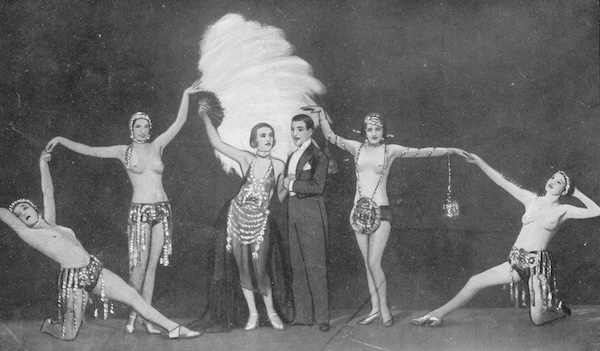
In Oran it was observed that Ladd ‘very much the exhibitionist, appeared on stage wearing a lion cloth’ this was removed to reveal a diamond studded G string and caused a flurry of complaints. Mistinguett simply shrugged her shoulders and said ‘if you’ve got it, flaunt it.’ It was also noted that during the tour Ladd was taking ‘liberties’ by his antics and having affairs with women including the actress Damia that infuriated Mistinguett.
The troupe must have returned to Paris in July 1931. At the beginning of August 1931, a strange conundrum arises as to where Ladd actually was. Incidentally, this is a situation that recurs and is strange and confusing.

On 1st August 1931 he was listed as being part of a military spectacle and vaudeville show given at the Colonial Exposition at Mount Verson Lawn, Vincennes. On the same date he was listed as being a performer aboard the liner Belgenland that departed New York for a week’s ‘showboat cruise.’ The ship left New York each Saturday, staged a different Broadway theatre entertainment with a range of notable Broadway stars every night, and spent two days in Nova Scotia before returning to New York. Clearly, one account is wrong. There are no listings of Ladd arriving in New York from Europe at this time to join the cruise so perhaps the latter is incorrect.
As it happens there are no indications of what Ladd was doing from August to early October 1931 but during this time he formed a dancing partnership with Mona Lee. Lee was an American dancer who had started out dancing in cabaret and picture house presentations from 1923. Arriving in Europe in late 1928 she was booked at various venues before she became part of Mistinguett’s show Paris Miss in late 1929 where she clearly met Ladd who was also in the cast. Before joining Ladd, she spent several months on tour with the famous Rocky Twins (who also starred in Paris Miss) in Scandinavia from about April-August 1931. It was later revealed that Mona Lee had allegedly refused a film contract from Hollywood to be with Tommy Ladd.
See the post about the Rocky Twins
Tommy Ladd and Mona Lee’s first performance at St Jean de Luz was either at the Casino Municipal or the Pergola in Mid-October 1931 so they may have begun their arrangement in the Biarritz area for the usual season in September and October. Toward the end of October they were back in Paris as Ladd was spotted at the latest nightclub ‘Croix du Sud’ in Montparnasse accompanying the dancer Jack Forrester, Edmonde Guy and one of the Guy sisters. In November 1931 the pair had moved south and appeared in picture palace stage shows at the Olympia, Bordeaux and the Gaumont Palace, Toulouse before appearing back in Paris in variety at the Alhambra. Here they opened in evening clothes doing a semi-acrobatic ballroom dance. Ladd then did a solo in sailors mess kit and then Mona Lee did a strictly acrobatic dance with somersaults. In the finale both did an acrobatic dance. Their act was noted to be ‘much faster than most European acts and well received’ and allegedly Molyneaux placed Mona Lee on contract to wear his clothes.
From Paris Ladd and Lee went East and in January 1932 they were on the variety bill at the Wintergarten in Berlin. It was also announced that Impresario Vincent Masi had booked them along with a range of other acts (Simone Sartihys, Régine Dancourt, the Sisters Nicholls, M. Josselin, Gaston and Andrée, Asuocion Granados, Wanda d-e Muth and a ballet international beauties) for a tour through France, Italy and Egypt. Later, Lee would confirm that they spent several months in Egypt perhaps through March – June 1932 and in July 1932 they were in Rome.
But by August 1932 things certainly get strange in terms of where they both were and what they were doing. There are no listings for the pair in Europe during the period August- late December 1932, but then they are listed as performing in Budapest, Hungary at the end of December 1932 and in early 1933 they appeared in variety at the Ronacher theatre in Vienna during January 1933.
From the available evidence Tommy Ladd must have returned to America in August 1932 even though there are is no confirmation from New York passenger arrivals at the time. He most definitely was in New York by August 1932 because a marriage license was granted to Helen Boice to marry Clarence J. Laventhal (Tommy Ladd) on 26th August and the pair were married on 4th September 1932.
Helen Boice was born on the 6th July 1903 in Savanna, Illinois and she and her family were still living there in 1920. By early 1923 she ventured onto the stage and developed a well-polished act that combined singing, dancing and humour as a duo with Olive Carew. The pair travelled to Australia and toured from June to November 1923. Although Boice was on the large side she had a snappy, vivacious personality and played the piano and later developed as a comedienne. They were regarded as both ‘clever’ and ‘artistic.’ However, there are no clues as to what Boice was doing between 1924 – 1927.

She bounced back again at the end of 1927 with her own act ‘My Piano and Me’ and then joined the cast of the show Hit the Deck that toured through 1928. By May 1929 she joined forces with Marge LaMarr in another duo giving a comedy skit with the theme of both being night club hostesses. Their humour skated on thin ice and they were described as ‘wise crackers extraordinary and very, very pleasing to the optics.’ They toured through 1929 and 1930, but sadly there are no indications of their activity in 1931. By July 1932 Boice (described as an ‘oversized comedienne’) was paired with Sally Marsh and toured in vaudeville and in August and September 1932 she must have been in New York.
What is a mystery is where Tommy Ladd and Helen Boice met and how long they courted. Since Ladd was in Europe in the summer of 1932 and Boice was in America how did they meet in the first place? Did she visit Europe in 1932 and meet Ladd there or was it simply a quick marriage upon meeting in New York in August 1932?
After 1932 Ladd took a different turn in his career and he reverted to being a singer again – remember that he had been a singer when young and starting out in California. In a chance meeting in a New York nightclub, he met three other like-minded musicians and singers (Jack Armstrong, Buddy Keehner and Paul Pegue) and joined them forming a quartette called The Admirals. They appeared in the new Schwab and DeSylva musical comedy called Humpty Dumpty staged in Pittsburgh before a New York opening n 12th October 1932 with Ethel Merman as the star. Thomas Ladd also appeared in the revue scene called Rah Rah Rah that represented five years of Musical comedy in five minutes. The show was a flop and lasted 5 days. It was then revised and retitled Take a Chance and was staged at the Apollo Theatre in New York from late November 1932. It became a big hit and continued until the beginning of July 1933. Once again, the Admirals were listed in the cast with Tommy Ladd being credited along with his three colleagues.
While Ladd was in New York appearing in Take a Chance, his wife Helen Boice was on tour around America with Sally Marsh all through 1933. The act was called After the Ride with songs and humour from Boice, that was deemed rather course, and the dainty, sprightly dancing of Marsh.
Next, there is another conundrum, because between the end of December 1932 and February 1933 Tommy Ladd was listed with Mona Lee performing in Budapest and Vienna. So how could he be in two places at the same time in Europe and New York? What might be likely is that Ladd had contracts to fulfil with Mona Lee and returned to Europe in December 1932 and then returned to New York after February 1933 to rejoin Take a Chance.
Ladd was back in Europe by August 1933 but by then his partnership with Mona Lee had ended. Instead, he formed a trio with two other American dancers Charlotte Mount (born 1910) and Grace Chamberlain (born 1908). They had been brought to Paris as part of a troupe called the Ambassadeurs American Girls managed by the New York dance instructor Maria Gambarelli for the cabaret show at the Ambassadeurs Restaurant in Paris staged from mid-May 1932.

The troupe subsequently joined the touring Mistinguett and Earl Leslie show Voila Paris that had a premiere in Zurich in early October 1932 and continued to tour into 1933. By the summer of 1933 they were back in Paris. It was here that Tommy Ladd made a trio with both Grace and Charlotte. They made their first appearance together in London at the London Pavilion and Romano’s restaurant in late August 1933. Through the rest of 1933 they also appeared at the Piccadilly hotel and the Kit Cat restaurant, made a few appearances out of town and toured various Stoll venues including the Manchester Hippodrome, Shepherd’s Bush Pavillion, Streatham Paramount Astoria and the Old Kent Road Astoria. They may have also performed at the Savoy Hotel at the end of 1933.
At the beginning of 1934 another strange conundrum arises with Tommy Ladd seemingly being in England and New York at the same time. Ladd, Grace and Charlotte are listed as dancing during January 1934 at the King’s Hall Swanage (5th January) and the Lewisham Gaumont Palace (17th – 26th January). At the same time – in January 1934 – Ladd was listed as performing in New York. I suggest that Ladd in fact left Europe for New York in late 1933 and although billed with Grace and Charlotte in England he did not appear. Interestingly, in the January UK listings a fourth partner called Fay Dawn was added – it is likely that she made up the trio in Ladd’s absence.
There were no listings for the trio of Ladd, Grace and Charlotte in Europe during the period February-April 1934 indicating that Ladd was busy elsewhere.
The New York ‘gig’ was a revival of the Admirals from the Take a Chance show with Ladd and his singing buddies Jack Armstrong, Buddy Keehner and Paul Pegue. The Admirals appeared first at the new Tic Toc Club atop the Park Central hotel in early January 1934. The venue was thought to be the ‘newest of the town’s swankier spots and probably the most gorgeous’ with a stained glass roof and ultra modernistic décor. The headline acts were Charles Judels and Irene Bordoni with Gypsy Markoff and her orchestra and the three Tic Toc glamour girls. From here they migrated with Irene Bordoni to ‘Suave Nick’s’ Simplon club by mid-January 1934. They were renamed the Royal Jesters or just simply the Jesters and described as a ‘novelty male quartet.’ It was said that they had ‘tiptop stuff authored for them by Jack Bassett and Manning Sherwin.’ Tommy Ladd of the Jesters did the limited conferencing in the simple announcements and Jack Armstrong was described as the falsetto comedian of the quartet.
It would appear that following this engagement the Royal Jesters performed in Palm Beach in February 1934 and then continued appearing in New York through the spring of 1934. Later, it was observed that they had been popular ‘broadcasters’ so it is highly likely that during this time they were regulars on the radio. However, trying to track their activity at this time is not easy as there were other acts called the Royal Jesters and Jesters operating at the same time.
By May 1934 Tommy Ladd was back in Paris. In mid-May the trio of Ladd, Grace and Charlotte, along with the charming Mexican artist Riva Reiss headlined at a series of galas staged at the Ritz Hotel. They were described as ‘gifted fancy steppers and crooners.’ By July 1934, they were performing at the Juan le Pins Casino and were clearly spending the summer on the riviera. Thereafter, Grace and Charlotte joined an Earl Leslie show that opened at Joao Caetano theatre, Rio de Janeiro in early November 1934 before returning to New York in February 1935.
Mysteriously, Ladd was most definitely back in New York from France for a very short period in August 1934 before crossing the Atlantic again aboard Lafayette in late August 1934 arriving in Plymouth, England on 1st September 1934 with Paul Pique and Victor (Buddy) Keehner. Their address in the UK was listed as the Café de Paris in Coventry Street. Along with Jack Armstrong (who was British and already in the UK) and as the Jesters they had been given a contact to perform and sing at the Café de Paris for a few weeks.

The Jesters were described as ‘one of America’s most popular singing and comedy acts who are regular broadcasters on the other side of the Atlantic’ and gave ‘some snappy New York stuff.’ As ‘harmonising humorists’ they had a batch of clever comedy songs that included some impressions of such stars as Bing Crosby, Kate Smith and Arthur Tracy. They also appeared on Eddie Pool’s popular radio broadcast.
At some point at the end of September the Jesters were replaced by the Four Yacht Club Boys also from New York and the quartet did a limited tour of the Stoll Circuit.
See the (Royal) Jesters performing in 1934 most likely in London, 1934 here
Finally, Ladd, Armstrong, Pique and Keehner returned to New York arriving 24th October 1934 aboard Berengaria. No doubt it was not long before they secured new engagements. Certainly, in December 1934 running through January 1935 they were appearing in a spectacular musical revue with Dan Healy at the Palais Royal Cabaret Restaurant on Broadway at 48thStreet. It was also noted that they had appeared at the St Moritz in New York.
In early February 1935, and billed as ‘the singing humorists’ they were featured at the Crystal Terrace in the Park Plaza Hotel. Described as a novelty male quartet they presented sophisticated songs and comedy including a satire on Faust that was one of the talked about hits of the season. New York’s foremost columnists called them ‘the top’ in rhythm entertainment.
From New York they were in Detroit in March 1935 appearing at the Penthouse night-club. Doris Robbins headed the floor show with Sondra and Winters dance team. The Royal Jesters featured straight numbers and songs of a sophisticated type, with lyrics that had not been heard before that was totally fresh and not the usual hackneyed material. By the summer the quartet was back in New York and at the Tilyou in Brooklyn.
Then Ladd and his wife Helen Boice embarked on a cruise together from 3rd -16th August 1935 aboard the Columbia. Boice, like her husband had also toured with her partner Sally Marsh during 1934 and 1935. This time husband and wife must have engineered an act to perform on the cruise on the Columbia that was regarded as the largest American cruise ship afloat at 40,000 tons, with three swimming pools and a sand beach on deck. The liner visited Saint Thomas, Curaçao, La Guaira, Colón, the Panama Canal, and Kingston, Jamaica. This was perhaps the first time that they had performed together and it was an arrangement that was to continue in later years.
Shortly afterward, Ladd returned home to California with a contract to appear in speciality dancing numbers in a new production of Anything Goes from producers Henry Duffy and Vinton Freedley that opened 2nd September 1935 in Los Angeles. The producers emphasised Ladd’s pedigree from his days in Paris but although the show was a resounding success Ladd must have only lasted a few weeks because he was back in New York by the end of September 1935.
Described as an ‘unusually smart quartet of sophisticated singing humorists’ the Royal Jesters performed for a few weeks from late September 1935 at the Normandie Restaurant, 112 Central Park South along with other acts in the floor show. It was observed that whilst in London, they had been prime favourites of the British princes, including Edward Prince of Wales as well as visiting continental nobility. Their repertoire of satire in song included such topics as college football, opera a la Noel Coward, radio idols and one of their most hilarious numbers was It Pays to Advertise – a sly dig at commercial radio sponsors. From New York they toured again and in late November 1935 they were at the Plantation, Niagra Falls.
This was probably the last ‘outing’ for the Royal Jesters and after 1936, Tommy Ladd performed solo in vaudeville and also in some shows but was seen increasingly with his wife Helen. The pair also relocated to Santa Monica in California (where Ladd’s family lived) and stopped touring America focusing on more local appearances. But from August – December 1939 Helen Boice and Tommy Ladd performed in Australia in vaudeville.
By the early 1940s they ran a nightclub called the Coocoonut Groove at 2627 Wilshire Boulevard, Santa Monica, that continued through the 1950s.
Tommy Ladd died in July 1971 and Helen Boice in May 1977
All images (unless specified in the caption) and text © copyright Gary Chapman / Jazz Age Club and must not be re-used without prior consent
Sources
Ancestry
The Mistinguett Legend by David Bret
Mistinguett by Mistinguett
Programme and souvenir brochure for Paris Miss
The Rocky Twins: Norway’s Outrageous Jazz Age Beauties
Programme of Humpty Dumpty in Pittsburgh
Programme of Take a Chance in New York
The Long Beach Telegram and The Long Beach Daily News 1/7/1924
The Register 14/12/1926
The Mid-Week News-Herald 14 /12/1926
Monrovia Day News 18/2/1927
New York Evening Post 30/9/1927
Times Union 22/8/1927
Universal Weekly 25/8/1934
Screenland 4/10/1940
Brooklyn Daily Eagle 20/11/1927
St Louis Post-Dispatch 29/4/1928
The Winnipeg Tribune 12/5/1928
Los Angeles Evening Post-Record 2/7/1928
Omaha Evening Bee-News 3/8/1928
Evening World Herald 9/8/1928
Variety 5/9/1928
Daily Echo 26/4/1924
The Stage 6/12/1928
The Era 5/12/1928
Eastern Counties Times 16/11/1928
The Stage 29/11/1928
Liverpool Echo 23/1/1929
The Stage 7/3/1929
The Stage 14/3/1929
The Stage 12/9/1929
Variety 2/10/1929
Chicago Tribune 25/10/1929
The New York Herald 9/9/1929
The New York Herald 22/11/1929
Variety 11/12/1929
Chicago Tribune 20/1/1930
Chicago Tribune 21/2/1930
The New York Herald 23/2/1930
Billboard 19/4/1930
Billboard 28/6/1930
Variety 2/7/1930
La Gazette de Biarritz-Bayonne et Saint-Jean-de-Luz 5/8/1930
Billboard 30/8/1930
Paris Soir 9/8/1930
L’Intransigeant, 16/8/1930
L’Intransigeant 4/9/1930
Le Figaro 7/9/1930
Variety 24/9/1930
Chicago Tribune 8/10/1930
Chicago Tribune 8/10/1930
Billboard 1/11/30
L’Echo d’Algier 23/12/1930
Billboard 10/1/31
Le Petit Marseilles 20/1/1931
International Herald Tribune 6/3/31
La France de Bordeaux et du Sud-Ouest 18/4/1931
De Avondpost 23/5/1931
Hamburger Echo 29/6/1931
Chicago Tribune 2/8/31
Variety 13/10/31
Variety 27/10/31
La France de Bordeaux et du Sud-Ouest, 7/11/1931
La Dépêche, 16/11/ 1931
Le Matin, 20/11/1931
Le Journal 20/11/1931
Variety 1/12/1931
Variety 8/12/31
Chicago Tribune 11/1/32
L’Intransigeant 17/1/1932
Variety 22/3/1932
Pittsburgh Press 16/4/1932
Hope star Arkansas 3/5/1932
Billboard 2/7/1932
The Spokesman-Review 18 Mar 1923
The Sun, Sydney 19/6/1923
The Mail, Adelaide 4/8/1923
News-Pilot 16/12/1927
The Eugene Guard 31/1/1928
Long Island Daily Press 6/5/1929
Long Island Daily Press 6/6/1929
Long Island Daily Press 7/6/1929
Albany Times September 1929
Atlanta GA Constitution 4/2/1930
The Winnipeg Tribune 18/6/1930
Billboard 15/11/1930
Billboard 9/7/1932
Variety 20/9/1932
Variety 29/11/1932
Billboard 10/12/32
Budapest Harlip 30/12/1932
Nepszavan 31/12/1932
Chicago Tribune 7/5/1932
Chicago Tribune 18/5/1932
The Tatler 8//6/1932
New York Herald Tribune 14/7/1932
La Liberte 22/9/1932
L’Indépendant des Basses-Pyrénées 13/12/1932
Paris-soir, 15/7/1933
Chicago Tribune 11/1/1933
Chicago Tribune 25/3/1933
Az Est 1/2/1933
The South Omaha Sun 15/2/1933
Omaha World-Herald 18/2/1933
The Stage 31/8/33
The Stage 7/9/1933
Variety 12/9/1933
The Era 20/9/1933
Variety 26/9/1933
The Stage 26/10/1933
The Stage 30/11/1933
Norwood News 1/12/1933
Lewisham Borough News 5/12/1933
Croydon Times 6/12/1933
Swanage Times & Directory 5/1/1934
The Era 17/1/1934
Sydenham, Forest Hill & Penge Gazette 26/1/1934
Brooklyn Eagle 2/1/1934
Brooklyn Eagle 10/1/1934
Variety 2/1/1934
Variety 23/1/1934
The Miami Herald 24/2/1934
Daily News 20/4/1934
Chicago Tribune 17/5/1934
Chicago Tribune 18/5/1934
Excelsior 23/5/34
Chicago Tribune 25/5/1934
Chicago Tribune 10/7/1934
Weekly Despatch 30/9/1934
Bystander 18/9/1934
Daily Mirror 13/9/1934
Bystander 25/9/1934
West London Observer 6/10/1934
Variety 6/11/1934
Times Union 8/2/1935
St Louis Globe-Democrat 9/2/1935
St Louis Globe-Democrat 9/2/1935
Variety 20/3/1935
Variety 17/7/1935
Variety 21/8/35
Los Angeles Evening Post Record 21/8/1935
Los Angeles Evening Post Record 28/8/1935
Variety 11/9/1935
Brooklyn Eagle 20/9/1935
Brooklyn Eagle 27/9/1935
Variety 2/10/1935
Buffalo Courier Express 28/11/1935
The Australian Women’s Weekly 14/10/1939
Los Angeles Evening Citizen News 31/1/1942
Los Angeles Daily news 9/5/1942
Westwood Hills Press 18/9/1958
Los Angeles Times 20/9/1958