The Valencia was a smart dance-restaurant in Charlottenburg, Berlin popular in the Jazz Age of the 1920s. It was opened and owned by George Tichauer and his brother Dagobert, who also ran the famous Barberina and Kakadu. Prior to this it had been the Café of the Theater des Westens and then a fashionable restaurant called the Palais Heinroth.
Tag Archives: 1920s dancing

Barberina, Tanzpalast
The fashionable Barbarina tanzpalast or night-club was situated at 18 Hardenbergstrasse in the Charlottenberg district of Berlin and was allegedly founded in 1921. It became one of the most prestigious of all dance-restaurants in Berlin in the Jazz Age of the 1920s.

Kathleen Zammit and Fidy Grube
Zammit and Grube were a German dancing team who specialised in arty acrobatics. They thrived for about 10 years from 1925 to 1935 and although originating in Germany and in particular Berlin, they travelled all over Europe and even the Near East and performed in Paris, London, Istanbul, Cairo, Dresden, Munich, Vienna, Copenhagen, Amsterdam and Stockholm.

Fred Dixon and Girlie
One of the most novel and amusing cabaret acts from the Jazz Age of 1920s London was that of Fred Dixon and Girlie. Dixon and ‘his girl-friend’ danced at the New Princess Frivolities cabaret show in 1926 and thereafter on the stage in two touring shows.

Harry Cahill
Harry Cahill was a multi-talented American dancer, female impersonator, singer and composer who became a popular and well-known figure in Paris during the 1920s and because of his achievements was once described as ‘a type of product of the Jazz Age.’

The Dancer Fay Harcourt
Fay Harcourt was a British dancer who made it big dancing in Paris in the Jazz Age of the 1920s as part of three dancing teams – the first with the American Harry Cahill, the second with a Russian called Nicholas and the third wit hthe Argentinian Peppy de Albreu. But, after a glittering career from 1922-1928 she simply vanished.
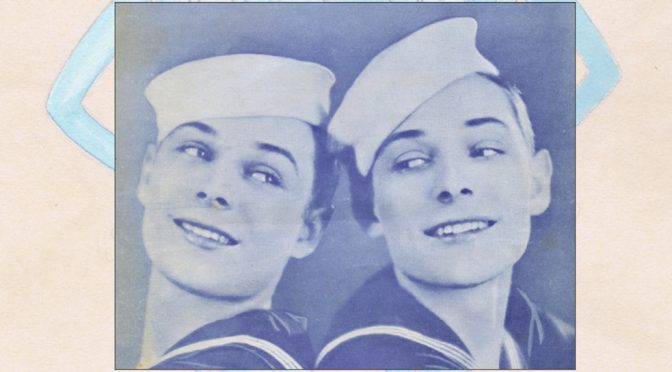
The Rocky Twins: Norway’s Outrageous Jazz Age Beauties
The Rocky Twins: Norway’s Outrageous Jazz Age Beauties by Gary Chapman
Admired for being stunningly handsome, the Norwegian Rocky Twins were dancers who had a ten-year career in Europe and America appearing on stage and in film between 1927-1937. Their beauty, their androgynous look and their outrageous antics made them legendary
Continue reading The Rocky Twins: Norway’s Outrageous Jazz Age Beauties
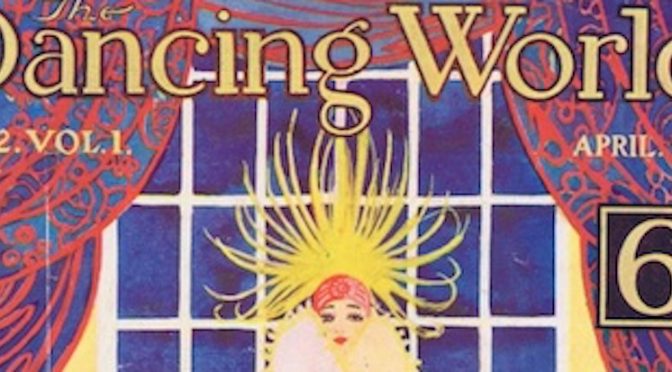
Dancing World Magazine
Dancing World Magazine
A few years ago I acquired a magnificent run of 25 copies of the rare British magazine The Dancing World. It is a remarkable publication spanning the period from May 1920 to at least March 1924, and at the last check, only one copy is held by the British Library. As a result this is a truly unique find that will be invaluable to researchers of the Jazz Age. But the bigger picture is that it also sheds light on the activity of William Mitchell who created the Palais de Danse in Hammersmith and Birmingham and was also behind Rector’s Club, one of the most fashionable nights-club rendezvous in London.