Tag Archives: 1920s
The Ambassadeurs Show 1929
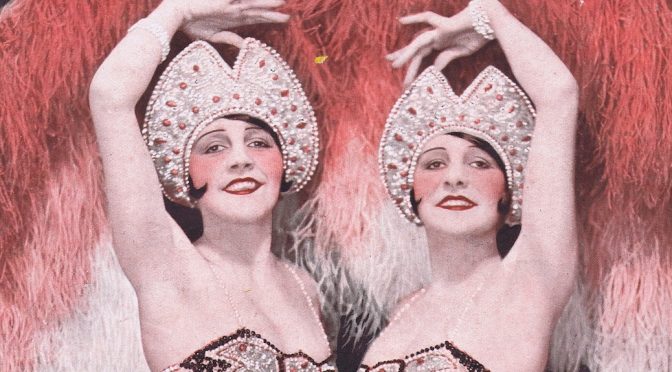
The fourth Ambassadeurs show in Paris was presented by Edmund Sayag in the summer of 1929 with a vaguely oriental but again distinctively American content.
Paddy the Next Best Thing (1923)
Herbert’s Wilcox’s second film with Mae Marsh, following The Flames of Passion, was Paddy the Next Best Thing, a romantic drama about a young tomboy and her growing love for a rich landowner set in Ireland and London, once again directed by Graham Cutts.
Broadway
Broadway : a cabaret and boot-legging drama of New York night-life
‘Broadway’ was regarded at the time as one of the best and slickest crime plays seen on the stage, laying bare the gangster racket in New York at the height of Prohibition in the mid 1920s. It was staged in both New York and London and was described as a thoroughly modern melodrama, although Theatre World insisted that the correct description, although a hybrid expression, was in fact a comedy drama.
Round in 50
Round in 50
Julian Wylie’s 1922 spectacular show for the London Hippodrome was Round in 50. It was not a golf problem but a ‘musical adventure’ designed as a vehicle for the hugely popular comedian George Robey, with the later addition of the American vaudeville star Sophie Tucker.
Josephine Earle
Josephine Earle
Josephine Earle was an American actress who made a name for herself at Vitagraph in a series of Vamp movie roles from 1915. She then made herself thoroughly at home in England during the 1920s appearing in British silent films, legitimate stage shows and cabaret.
The Flames of Passion (1922)
Flames of Passion (1922)
One of the earliest ground breaking British silent films from Herbert Wilcox and Graham Cutts was The Flames of Passion starring the American actress Mae Marsh and a solid British cast.
The Peepshow
The Peepshow
The debut revue from the Julian Wylie and Jas W. Tate organization at the London Hippodrome was The Peepshow launched 14th April 1921. Described as a tropical fantasia it proved to be a runaway success partly because several of the main scenes had already been tried and tested in previous Wylie–Tate productions, and so from the outset, the production was viewed as being polished and well produced.
Who was Gertrude Johnson?
A few years ago a batch of rather delightful costume designs were sold on ebay all drawn, and many signed, by the rather enigmatic Gertrude A. Johnson. But who was Gertrude Johnson? Since the drawings come from America one can deduce that she was American and the distinctive style of her work, reflecting the prevailing eccentricities of the Jazz Age, clearly places them in the 1920s.